


Introduction
Emerging Tech Trends 2026 Emerging Tech Trends are changing the way people live, work, learn, and communicate in today’s fast-moving digital world. From smart devices and automation to data-driven systems and intelligent software, technology is evolving faster than ever before. For beginners and intermediate readers, understanding these changes is no longer optional. It has become essential for career growth, business success, and everyday life decisions. Emerging Tech Trends influence how companies operate, how students learn new skills, and how individuals interact with technology daily.
In recent years, businesses of all sizes have started adopting modern technologies to stay competitive. Small startups now use tools that were once available only to large enterprises. At the same time, governments and educational institutions are also investing heavily in digital transformation. This growing reliance on technology makes it important to understand what trends are rising, why they matter, and how they can be used effectively.
Moreover, Emerging Tech Trends are not limited to one industry. They impact healthcare, education, finance, manufacturing, marketing, and even entertainment. These trends help improve efficiency, reduce costs, enhance user experiences, and create new opportunities. However, they also bring challenges such as security risks, skill gaps, and ethical concerns.
This article is designed to explain Emerging Tech Trends in simple English with practical examples. It will guide you step by step, highlight benefits and risks, answer common questions, and share expert tips. Whether you are a student, professional, or business owner, this guide will help you understand the future of technology clearly and confidently.
What is Emerging Tech Trends?
Emerging Tech Trends refer to new and developing technologies that are gaining attention and adoption across industries. These technologies are not fully mature yet, but they show strong potential to shape the future. They often start as innovations in research labs or startups and gradually become mainstream solutions.
In simple words, Emerging Tech Trends are technologies that are “on the rise.” They represent new ways of solving problems, improving processes, and creating value. Examples include advanced automation, smart data systems, connected devices, and next-generation computing solutions.
These trends usually grow because of changing user needs, business demands, or global challenges. For instance, the need for faster communication, better security, and smarter decision-making drives the development of new technologies. As these solutions prove useful, more people begin to adopt them.
Another important point is that Emerging Tech Trends are interconnected. One trend often supports or enhances another. For example, data-driven systems rely on cloud platforms, while automation depends on intelligent software. Together, they create powerful digital ecosystems.
Understanding Emerging Tech Trends helps individuals and organizations prepare for the future. It allows them to learn relevant skills, make informed investments, and avoid being left behind in a competitive digital landscape.
Why is Emerging Tech Trends Important?
Emerging Tech Trends are important because they define how the future will function. They influence productivity, innovation, and economic growth at every level. When businesses adopt new technologies early, they gain a competitive advantage and can respond faster to market changes.
For individuals, these trends open new career paths and learning opportunities. Many traditional jobs are changing, while new roles are being created. Skills related to modern technology are becoming more valuable and in demand.
In addition, Emerging Tech Trends improve efficiency and accuracy. Automated systems reduce human errors, while smart tools help analyze large amounts of data quickly. This leads to better decisions and improved outcomes.
Another key reason is customer experience. Modern users expect fast, personalized, and secure services. Emerging technologies help organizations meet these expectations by offering smarter and more responsive solutions.
Finally, these trends play a role in solving global challenges. From improving healthcare access to reducing energy waste, technology-driven innovations contribute to sustainable development. Ignoring Emerging Tech Trends can result in missed opportunities and long-term disadvantages.
Detailed Step-by-Step Guide
Step 1: Identify Relevant Tech Trends
The first step is to understand which Emerging Tech Trends are relevant to your goals. Not every trend applies to every person or business. Start by observing your industry, interests, and future plans.
Look for technologies that solve real problems or improve existing processes. For example, data analytics may be useful for marketing, while automation may benefit manufacturing.
Reading industry news, attending webinars, and following expert opinions can help you identify important trends. Focus on trends that show consistent growth and practical use cases.
Step 2: Learn the Basics Clearly
Once you identify relevant Emerging Tech Trends, the next step is learning the basics. You do not need advanced technical knowledge at the beginning. Focus on understanding how the technology works and what problems it solves.
Use simple learning resources such as beginner guides, tutorials, and short courses. Break complex concepts into smaller parts to avoid confusion.
Clear understanding at this stage builds a strong foundation and increases confidence when exploring deeper topics later.
Step 3: Analyze Real-World Use Cases
After learning the basics, study how Emerging Tech Trends are used in real life. Real-world examples make abstract concepts easier to understand.
For instance, automation can be seen in customer support systems, while smart data tools are used in recommendation platforms. Observing practical applications shows the true value of a technology.
This step also helps you understand limitations and challenges, which is important for realistic expectations.
Step 4: Start Small and Experiment
You do not need to invest heavily at the beginning. Start small by experimenting with basic tools or trial versions. This approach reduces risk and allows hands-on learning.
Small projects help you gain practical experience and identify whether a technology suits your needs. Mistakes at this stage are learning opportunities.
Gradual experimentation builds skills and prepares you for larger implementations in the future.
Step 5: Build Skills and Stay Updated
Emerging Tech Trends evolve quickly, so continuous learning is essential. Build relevant skills through practice, training, and collaboration.
Stay updated by following industry updates and learning about new developments. This habit ensures long-term relevance and adaptability in a changing digital environment.
Benefits of Emerging Tech Trends
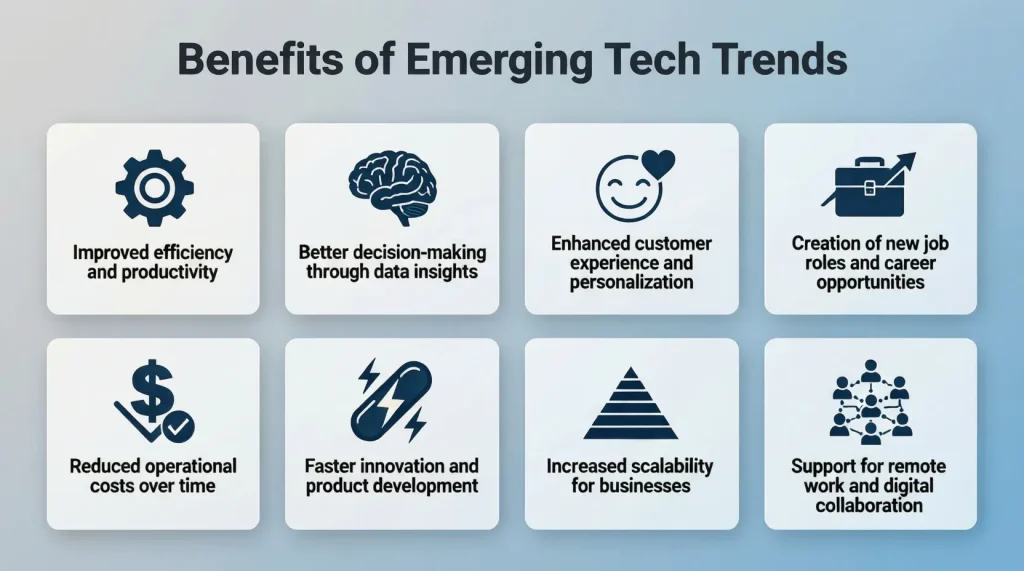
- Improved efficiency and productivity
- Better decision-making through data insights
- Enhanced customer experience and personalization
- Creation of new job roles and career opportunities
- Reduced operational costs over time
- Faster innovation and product development
- Increased scalability for businesses
- Support for remote work and digital collaboration
Disadvantages / Risks
- High initial implementation costs
- Security and privacy concerns
- Skill gaps and learning challenges
- Dependence on technology systems
- Ethical and compliance issues
- Risk of job displacement in some sectors
- Rapid changes leading to uncertainty
Common Mistakes to Avoid
One common mistake is following every new trend without evaluation. Not all Emerging Tech Trends are suitable for every situation. Blind adoption can waste time and resources.
Another mistake is ignoring security and privacy considerations. New technologies often introduce new risks that must be managed carefully.
Many people also underestimate the learning curve. Expecting quick results without proper training leads to frustration and failure.
Finally, avoiding long-term planning is a major issue. Emerging technologies require strategic thinking and patience to deliver real value.
FAQs
What are Emerging Tech Trends in simple terms?
Emerging Tech Trends are new technologies that are becoming popular and are expected to shape the future. They focus on improving efficiency, automation, and digital experiences.
Who should learn about Emerging Tech Trends?
Students, professionals, business owners, and decision-makers should learn about these trends. Understanding them helps in career growth and better planning.
Are Emerging Tech Trends expensive to adopt?
Some technologies require high initial investment, but many offer scalable and affordable options. Starting small helps manage costs effectively.
How often do tech trends change?
Technology evolves rapidly. Some trends last for years, while others change quickly. Continuous learning is important to stay updated.
Can small businesses benefit from these trends?
Yes, small businesses can gain efficiency, improve customer experience, and compete with larger companies by adopting suitable technologies.
Is technical background necessary to understand these trends?
No, a technical background is not required. Basic understanding and willingness to learn are enough for beginners.
Expert Tips & Bonus Points
Focus on problem-solving rather than technology itself. Tools should support clear goals and needs.
Always test before full implementation. Pilot projects reduce risk and improve outcomes.
Invest in skill development alongside technology adoption. People and tools must grow together.
Think long term and stay flexible. Emerging Tech Trends require patience, adaptability, and strategic vision.
Conclusion
Emerging Tech Trends are shaping the future in powerful and meaningful ways. They influence how businesses operate, how individuals build careers, and how societies solve complex problems. Understanding these trends is no longer limited to technical experts. Today, everyone can benefit from learning how modern technologies work and how they can be applied effectively.
By exploring Emerging Tech Trends step by step, beginners and intermediate learners can reduce confusion and build confidence. The key is to start with clear goals, learn the basics, observe real-world examples, and experiment carefully. While challenges such as security risks and skill gaps exist, the benefits often outweigh the disadvantages when managed wisely.
In the long run, staying informed and adaptable is the most valuable strategy. Technology will continue to evolve, but those who understand its direction will always be better prepared. Emerging Tech Trends are not just about the future. They are about making smarter decisions today to create better opportunities tomorrow.


